
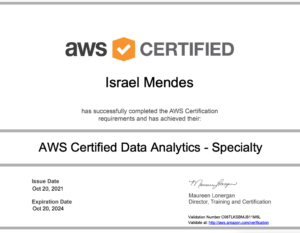
Recently, I was assigned to a few specific projects involving AWS and I decided to take a certification from that platform. My first choice was to go straight to the AWS Data Analytics Specialist exam, although could be tough because I never took a certification from AWS before, but still decided that I could learn a lot even if I would not pass the exam.
After one month and a half, close to 70 hours of study and a lot of anxiety, I passed the exam and became certified by AWS. It was a great experience, I learned so much and I decided to share a little bit of my process and learning for anyone that might be interested to take the exam.
Why do this certification?
This is the initial step that all of us need to make, by questioning the why. AWS has several certifications, so GCP and Azure. Almost all cloud provider has a certification specific for data. The real question is why focus on data and not on security, DevOps, networking or even machine learning? For my case, I wanted to apply a lot of the learning from this exam into my day-to-day job.
Your case might be different. You might want to migrate from one area to another and believe that the exam is a good way to set that. Or just for the sake of learning and challenge that might interest you. What ever the option is, just study and know the difference certifications and cloud providers. AWS has exams focused on associate, professional and specialist level, for example. If you decide to move with one specific exam, just make sure you explored all the possibilities and contents of each exam, to be certain that this is what you look for.
Is important to highlight that the exam is just a “paper” (more like a PDF file, really). You won’t magically have “super powers” in the cloud. There some basics knowledge that you will need to have to deliver a good job (e.g. know about subnets, VPCs, encryption, security groups and even IaC). This is why having a specialist certification MIGHT not be a good option for you if you don’t have a lot of knowledge or experience in that cloud in general.
Preparation
Talking a little bit about my preparation and the process:
- I studied from 13 of September, 2021 to 20 of October, 2021 – being the date of my exam.
- Being 6 weeks in total, I used in the following process:
- First week was focused on online courses and labs to have a more hands-on-experience with specific services.
- The other 5 weeks were dedicated to practice exams. A LOT of questions, close to 600 in total! Combined Anki with the questions I collected from several materials to revisit the most “weak” materials in my mind more frequently.
About my study and some data involved. Some learning of the process:
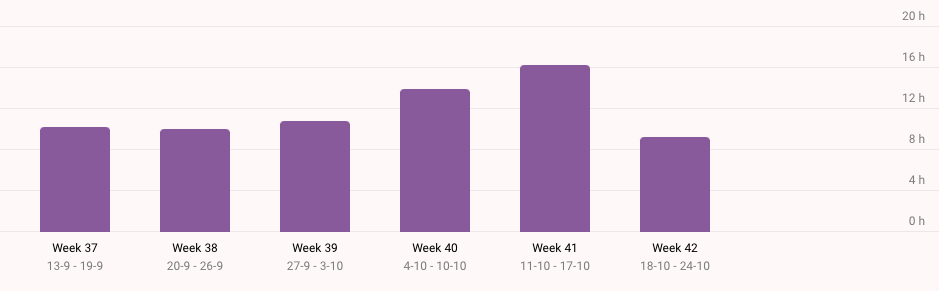
- It was a total of 70 hours, with an average close to 11 hours and half for each week.
- I used to, initially, study 2 hours per day from Monday to Friday and take a break on the weekends.
- But, the more I got close to the exam, I started to increase the number of days and hours, studding on Saturday, Sunday and more on the weekdays.
- This I believe to be one of my mistakes, trying to study more and more when the exam got closer instead of having enough time to really learn. This is way I was getting nervous and with no breaks between the studies and working, this process made me more anxious than ever in this preparation.
Materials
A few resources that I have used:
- Whizlabs: Great classes and labs about the Data Analytics Specialist. Had several practice questions that was super helpful in the exam.
- Udemy – AWS Certified Data Analytics Specialty Practice Exams: Great practice questions and quite good explanation.
- AWS Certified Data Analytics Study Guide: Specialty (DAS-C01) Exam: Excellent book that goes in details for the resources used in AWS, but the book has a high price tag. One of the things that I loved about this resource is that it provides a test bank with close to 250 practice questions. Although several are duplicates, you still can learn a LOT from them.
- Anki: A free software that allows you to revisit the questions that you might be falling more often. Since I collected a lot of questions, I used Anki to organize and revisit only the elements I needed, instead of seeing everything and losing a lot of time.
Test and results
I will avoid to go into details about specific questions, but in general terms, the test follow the similar structure:
- Provides a scenario and a problem to solve for a client / company.
- There is several ways to solve the problem, but you need to be paying attention to not provide a over-engineering and expensive solution when the client in the question might not need it.
- I had a lot of questions about:
- Receiving the data (e.g. Glue ETL, DMS, DataSync, Kinesis),
- Data being stored (e.g. S3, HDFS, EMRFS, partitions, ElasticSearch/OpenSearch),
- Processing (e.g. Athena, EMR, Glue, Spark/Hadoop),
- Serving the data (e.g. Redshift, multi-AZs, Kibana).
- I didn’t received a lot of questions about data visualization (e.g. Quicksight, what types of graphs to use) or specifics about EMR processing (e.g. when to use Flink, Spark, Hive, Pig and so forth).
- A few things that I wish to spend more time learning and that was a frequent topic in the exam:
- How the different resources of Kinesis works and each detail (e.g. what is the difference between KPL and KCL, when to use Kinesis Firehose or Kinesis Analytics, whe Kinesis Analytics can or can’t do).
- Types of compression and distribution key from Redshift.
About my results, I had:
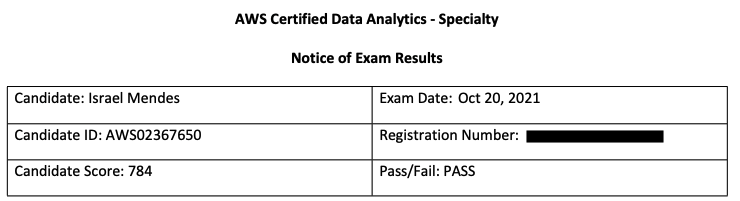
My score was 784, when the passing score for the exam was 750. Very close, to be honest. Here is a learning for myself that I should have spent more time, like 2 to 3 months instead of 1 and half, improving a little bit more into this “margin”.
As we know, the certification don’t provide details about the score based on each section or even how many questions I got right or wrong. But in the AWS Training and Certification, the place you will or have already schedule a exam, there is a part about Previous Exams and with the Score Report. In this part the site provides a PDF file that explains a little bit more about the performance on the exam:
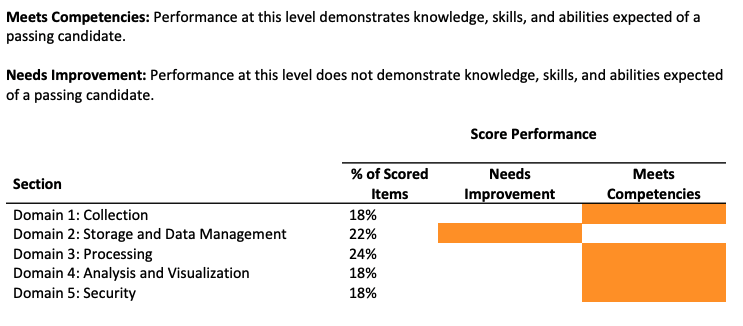
I went well and in all of the areas, except Storage and Data Management. The sad part is that I don’t know exactly how much I’m good or bad in the sections. But, either way, this is a good way to understand more where I need to pay attention even after the exam.
Conclusion
After I passed the exam, I felt a huge relief for finally finishing after weeks of anxiety. But I believe that there was a good experience overall. A learned a lot in the process and I know that I will apply my knowledge well in the projects that will come.
Interesting enough, AWS provides several benefits that I wasn’t aware of:
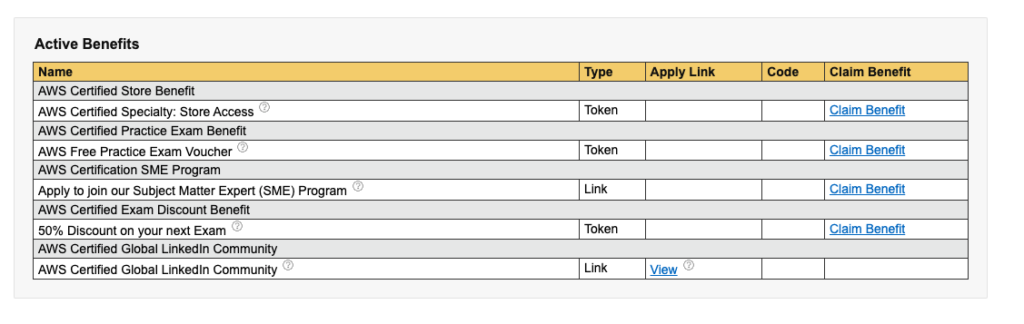
The certified practice exam benefit and discount for the next exam are great!
If you are willing to study and put the necessary hours (e.g. 2 to 3 hours per day) for a couple months, I would suggest for you to consider the exam for sure. Just check the other exams first, like the Developer Associate or Solutions Architect Associate, as they will be useful to prepare yourself for the specialist exams. Good luck!