
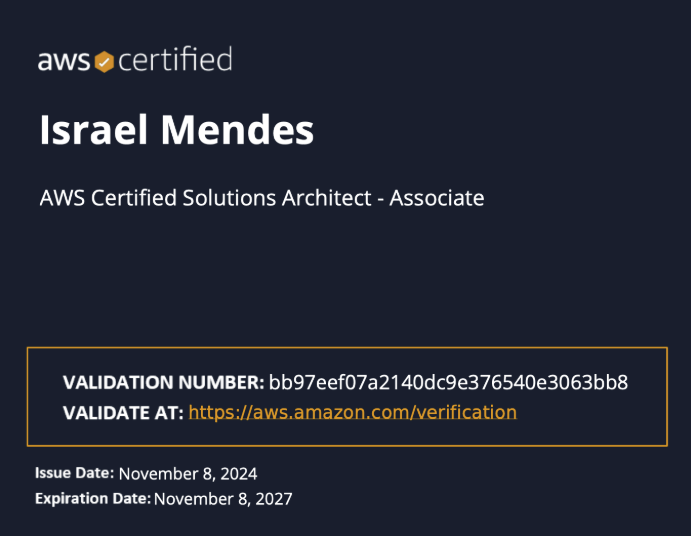
I decided to share a bit about my experience while being a more “data” person and passing for the AWS Solutions Architect – Associate. I will use this article to explain my process, talking what I did differently from the other certifications that I took,, and list some things I learned.
I started studying for this certification around September 18, 2024. My last study day, the exam, was November 8—so, counting around 51 days, or close to 2 months, studying a few hours.
The Process
I always use similar methods to start studying for a new technical certification and plan to continue using them. Here it is:
- Start with a broad course: Study the certification topics to learn about things you don’t know, like particular tools on AWS or details that matter later. For example, I was learning about the existence of an Egress-only Internet Gateway for IPv6, which I learned in one of my courses. I also had a question about it during the exam.
- Implement proof-of-concepts or labs. This is time-consuming but useful if you have a gap in your knowledge. It was when I set up the VPC and networking for two AWS accounts, then connected each using VPC Peering. Just be aware that you should not do a POC for everything since the focus is the certification itself.
- Lots of questions: Once you get a sense of the exam’s content, start practicing with questions provided on places like Udemy or Whizlabs. I prefer to store them in Anki flashcards. The front is the question, and the back of the card would be the answer. Review a bunch of them, around 200 to 300 questions. Once I get consistent, correct answers, I will go to the next step.
- A good tip here is to spend more time reviewing questions that you have a hard time with. This is why Anki is useful. It organizes that process so you can review more challenging questions.
- Another good tip is to understand the pattern of your weaknesses. Mine was that I would do poorly on questions related to S3 storage. So, I spent time creating a summary to see the difference between each storage and detail and working with several questions to consolidate my knowledge.
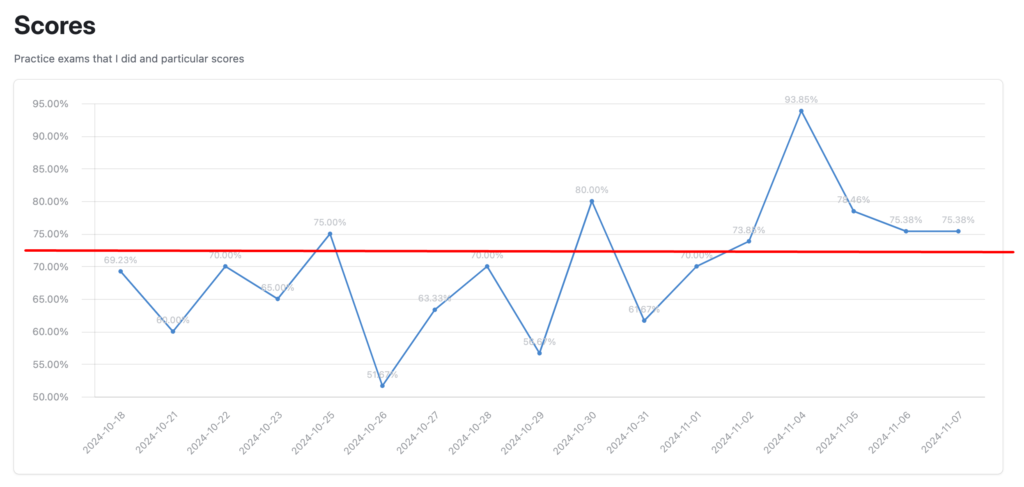
- Practice exams: How do you know you’re ready to do the exam? Similar to “dry runs” in the computing world, you have to do a simulated execution to ensure that you can do it. Instead of doing all the questions like in step 3, I will reserve several practice exams from different sites and sources and do one or twice per week. I will schedule the exam if I consistently get a good score (75% or higher).
- Real exam:
- On the day before the exam, I will prepare my workstation to ensure that nothing is forbidden. I aim to get to bed early and relax as much as possible.
- I will try to wake up a bit later than usual on the exam day. After a good night’s sleep, I will review a few questions, but at most 50 or something similar, to avoid getting stressed. Another tip I would like to do is to review it question by question. If I notice a challenging question, I will flag it and move forward. Once I reach the end of the exam, I will revisit the questions that I flagged and try to answer the “hard” questions. This process helps my brain work in the background to find the solution for those tricky situations
- Once I have completed the exam, I will relax or try to do something besides thinking about it, like going to the gym or working.
- Self-Evaluation: It is essential to go back mentally and understand the good things you did during this preparation and the bad things you need to redo, and document that in some place so you can revisit them. This whole article is my attempt to document what I learned and self-evaluate during that process.
My Metrics
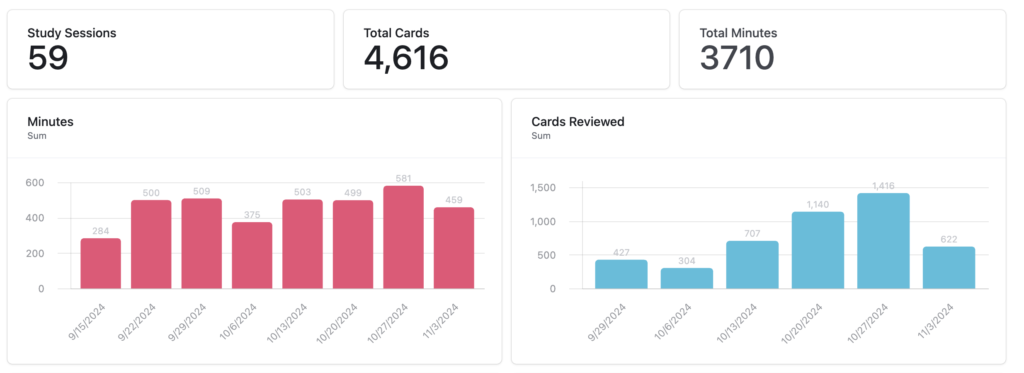
I decided to log in to Airtable for all my study sessions and their duration and, later, practice questions. This way, I could visualize the numbers and better assess my results.
My main numbers were:
- 59 study sessions around 51 days.
- 4,6k cards reviewed, in those cases questions from practice exams in Anki.
- Spent 3,7k minutes for all the study sessions or around 62 hours.
- Some additional insights:
- I spent a similar amount of time every week, from courses to practice exams.
However, I increased the number of questions reviewed over the weeks since I improved. - Last week, I was focused on practice exams, so I would review less common questions and focus on new ones to prepare for the exam.
- I spent a similar amount of time every week, from courses to practice exams.
More information here:
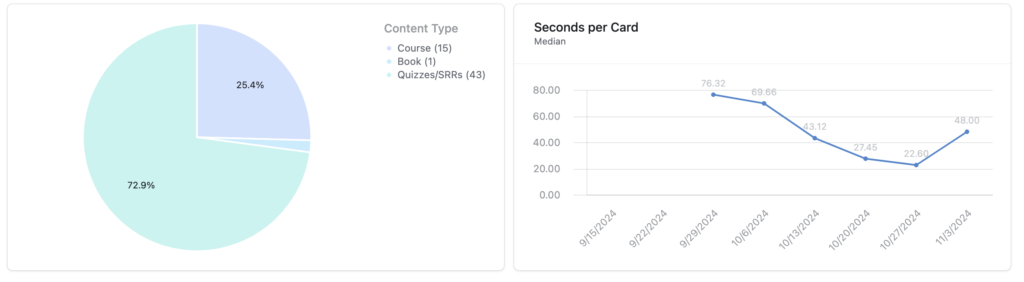
- 73% of the study sessions were focused on quizzes and flashcards from practice questions.
- I reduced the time per card/question over the weeks, improving with every study session.
I took practice exams from different sources to determine whether I was ready for the certification. Below is my result per exam, where the red line indicates the minimum score I should aim for (72% because the 720 score is required to pass for the Associate certification). As you can see, I got low grades until the last days/weeks, consistently getting a bit above the minimum.
Conclusion
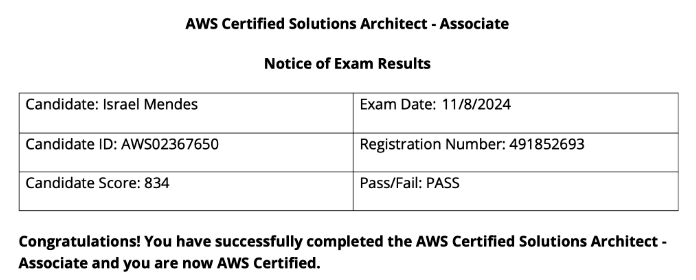
After this whole process, I was able to pass the exam with one of the best scores ever for me, 834:
Comparing my performance per exam in the past, that would be:
| Exam Date | Certification Name | Score |
|---|---|---|
| 2021-10-20 | AWS Certified Data Analytics – Specialty | 784 |
| 2021-12-29 | AWS Certified Developer – Associate | 770 |
| 2022-12-08 | AWS Certified Machine Learning – Specialty | 815 |
| 2024-11-08 | AWS Certified Solutions Architect – Associate | 834 |
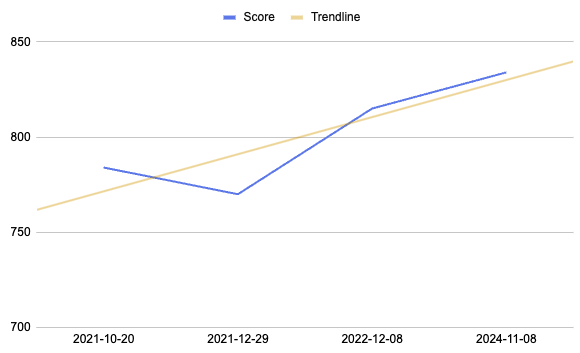
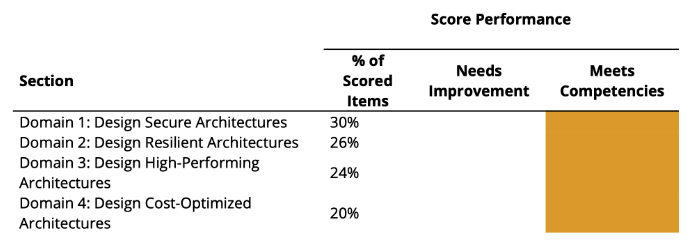
I hope to continue following that trend. I checked the score performance per section, aiming to improve while self-evaluating, and I did well in most of them.
I’m happy to have insisted on this certification. It was challenging, but I’m glad I went ahead since I learned so much. Now, it’s your turn to study for it and take that exam!