
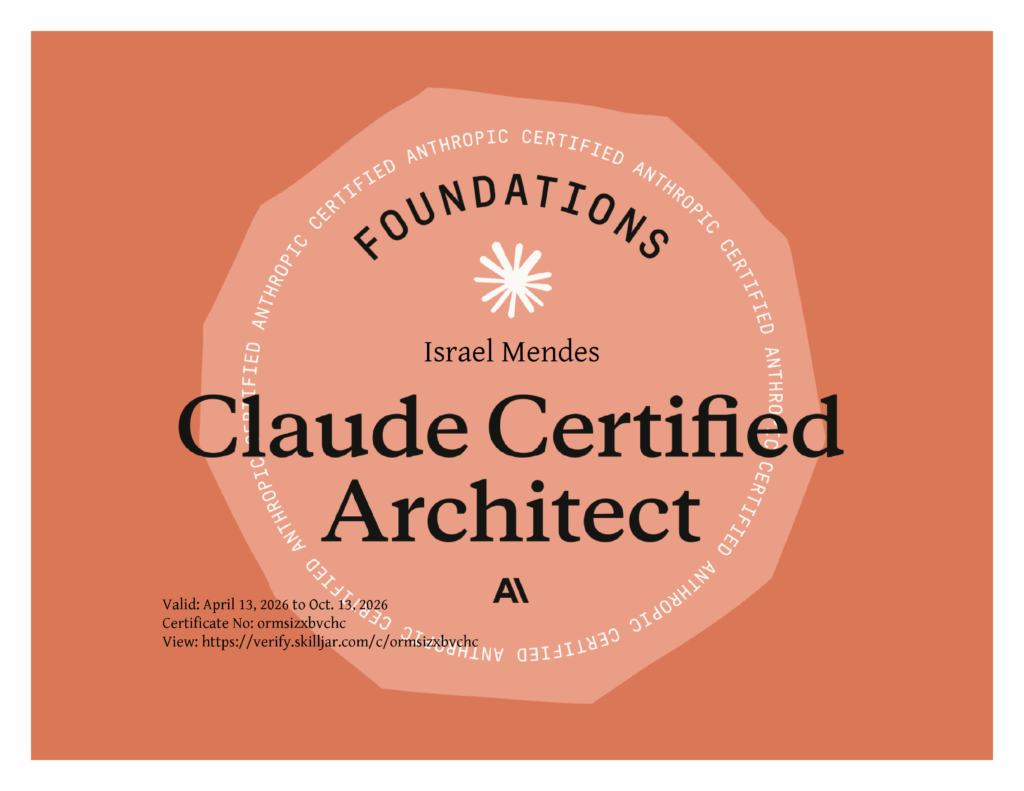
Important to mention that the certification is quite new, and I assume that the tips here can become a bit outdated in a few months. So consider that before studying for the certification and always check the Exam Guide for the latest information from Anthropic.
I decided to take advantage of the fact that the company I work for, Caylent, is an Anthropic partner and study for the Claude Certified Architect – Foundations exam. I’ve written about my experience with other certifications, and this one was special because it doesn’t have a lot of materials out there. Because of that, I had many people asking about my process, so I’m sharing here a longer version to assist others.
Talking about the test: it has 60 questions, and it is divided into 5 core competencies:
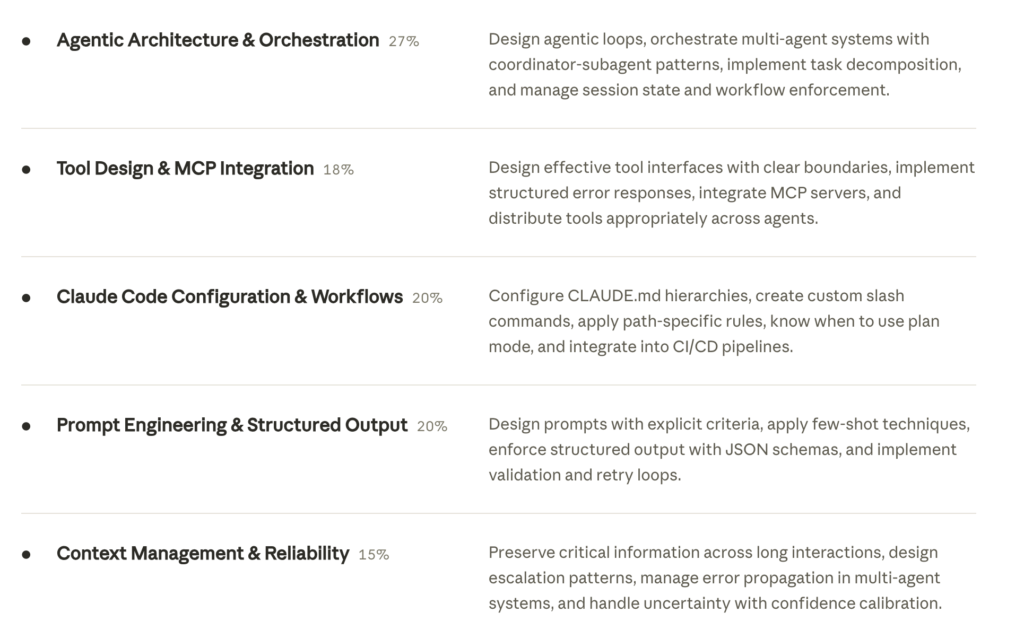
Important to say that those competencies are a bit distinct from the scenarios that you will face. My understanding is that:
- Core competency: Basic elements that you will be evaluated on
- Exam scenario: A situation that will evaluate the core competency. You will not be evaluated for every scenario. Each exam draws 4 scenarios at random from this set of 6.
The scenarios are:
- Customer Support Resolution Agent
- Code Generation with Claude Code
- Multi-Agent Research System
- Developer Productivity with Claude
- Claude Code for Continuous Integration
- Structured Data Extraction
Tip: The exam guide is your best friend, from the beginning to understand each core competency/exam scenario until the moment you access your results after you complete the exam.
Let’s talk about my workflow in detail:
How did I study for it
First, here is a summary of my numbers while studying for the certification:
- Start date: April 11
- End date: April 26
- I spent, roughly, 16 days in this study process
- Total questions responded to in practice exams: 480
An important disclaimer: Keep in mind that I was able to take the exam in around 2/3 weeks because I work with Claude (specifically Code, Agent SDK, and with MCPs) daily. Your situation may be different, and you may need more time to prepare. Plan accordingly because, if you don’t pass the exam, you might need to wait a bit to retake it.
My process was honestly straightforward. I will list the main resources at the end of the section, but here is how I did it before the exam:
- Before the study of the certification, I built some applications in Python using the Agent SDK. I recommend having some hands-on experience there, like building something with Claude Code, developing an MCP or multi-agent product to make it easier for your learning.
- I started to take some courses on Anthropic Academy and to read some blog posts related to the agents and LLMs in general
- Went over the practice exams. That was the most consuming part. I would take maybe 2 hours to go over 60 questions and take notes of my mistakes, then do another 60 questions and another 2-hour session.
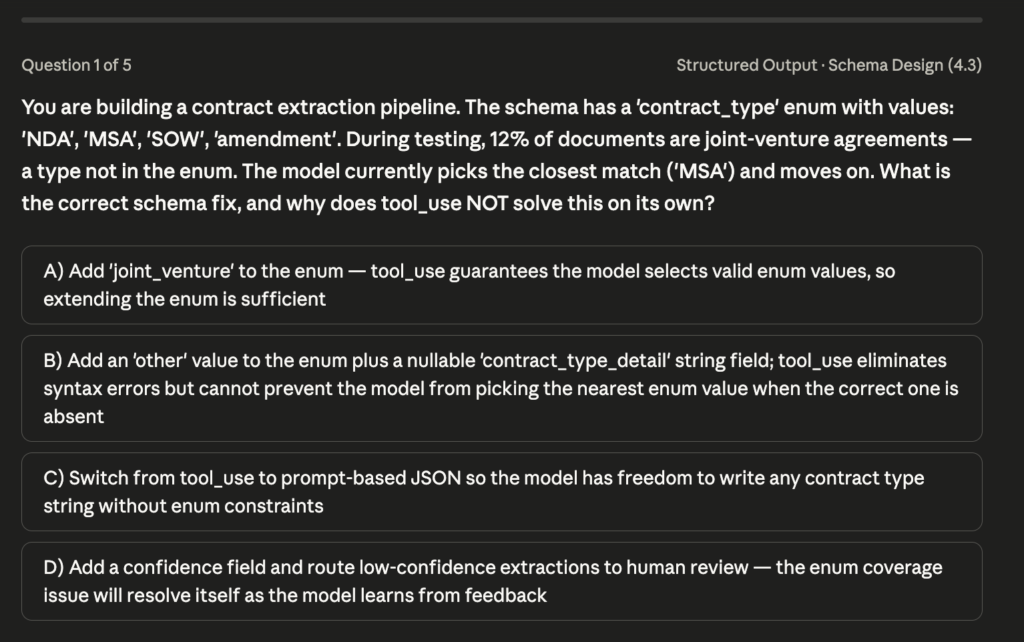
Tip: Once I started to notice the patterns based on the questions I faced on the mock/practice exams, I would feed the Exam Guide to Claude and ask it to generate questions on my mistakes/failures. This helped me a lot to advance on my weaknesses:
Data Analysis Prior Exam
Every time that I would go over some practice/mock exam, I would “log” my performance per competency and major score overall in a simple spreadsheet. Right in the last few days of my preparation, I used that to feed into Claude, and I asked it to generate some interesting insights that I want to share here:
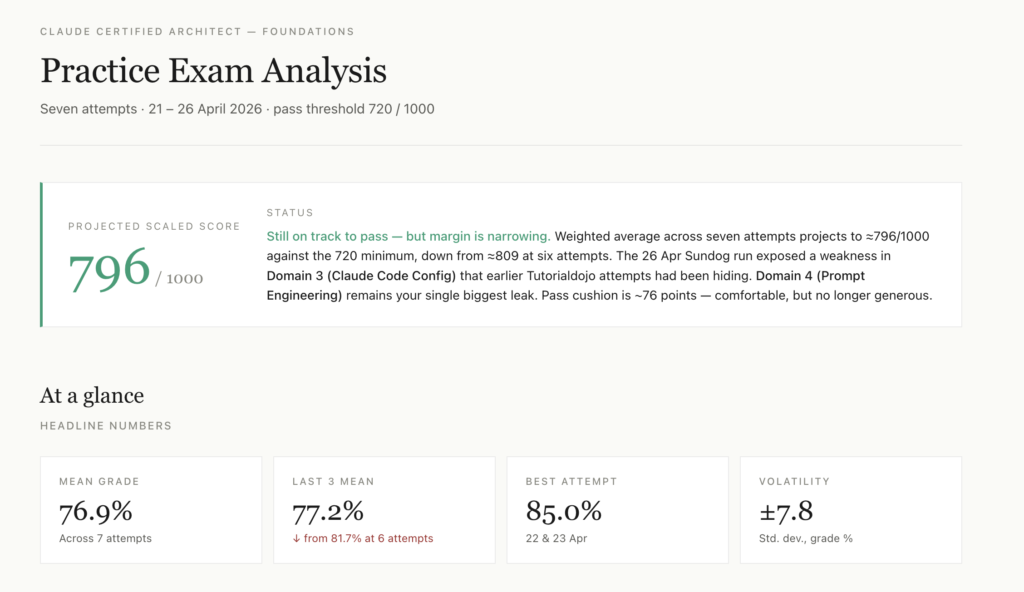
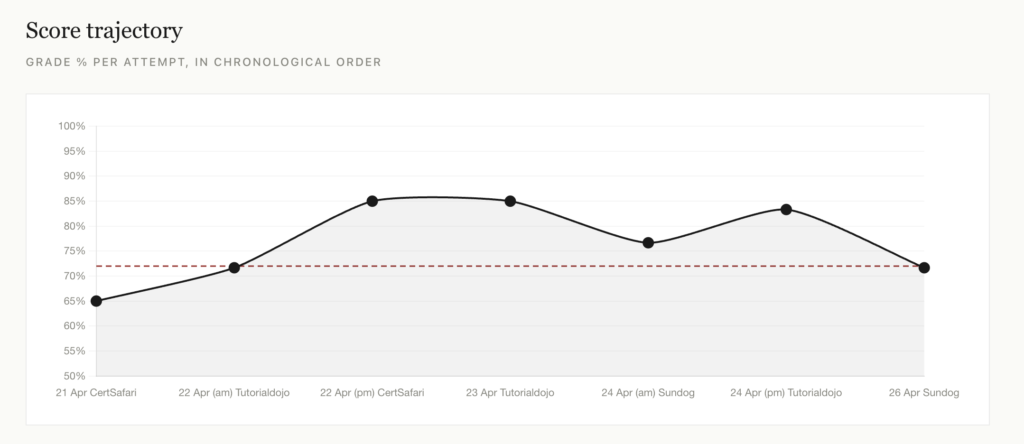
Above, we have some basic numbers, which are useful overall to understand if I’m good to move forward with the exam or not. But let’s dive into it. Here are my score per mock/practice exam that I took:
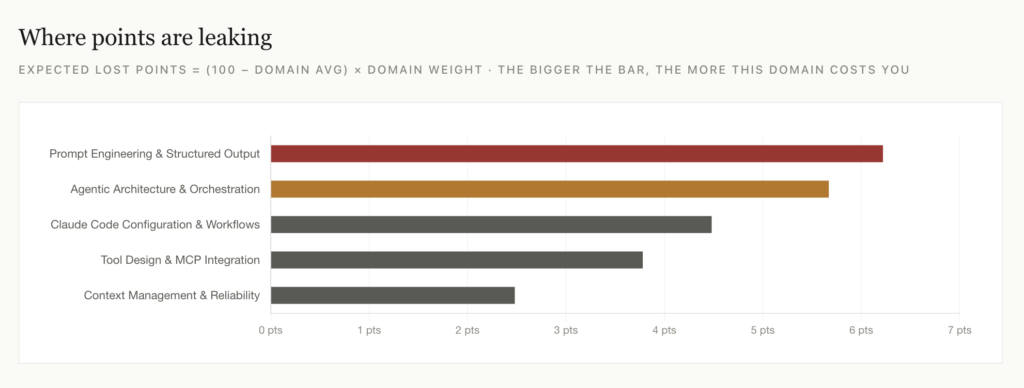
This section below was the most important for me: instead of spending time reviewing questions and competencies/domains that I already had some good knowledge of, I would plot and see which ones I could improve (or which ones I needed to pay more attention to because of the relevance in the exam structure). For example, the main ones that I spent time on in the last days of the exams were (in order of priority):
- Prompt Engineering & Structured Output
- Agentic Architecture & Orchestration
- Claude Code Configuration & Workflows
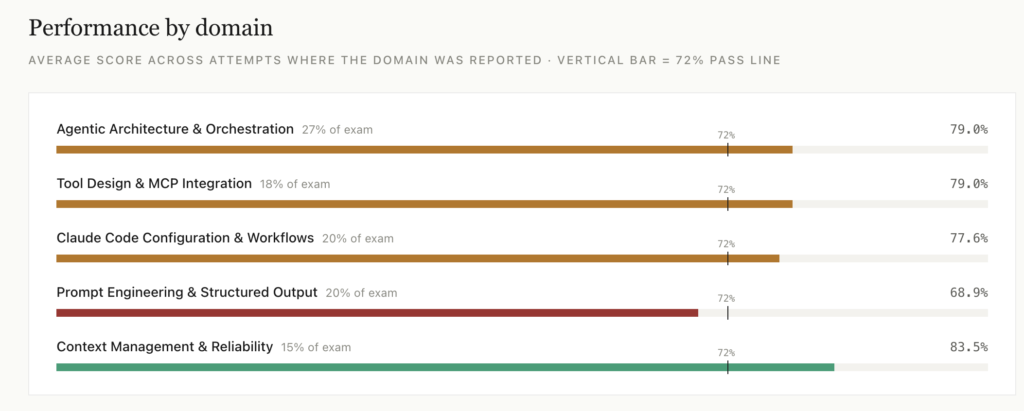
Tip: Aim to track your performance when going over the questions, and try to break it down into smaller buckets (per competency, scenario, domain, tools). This can help you identify which areas to put your time and priority on to improve your overall results.
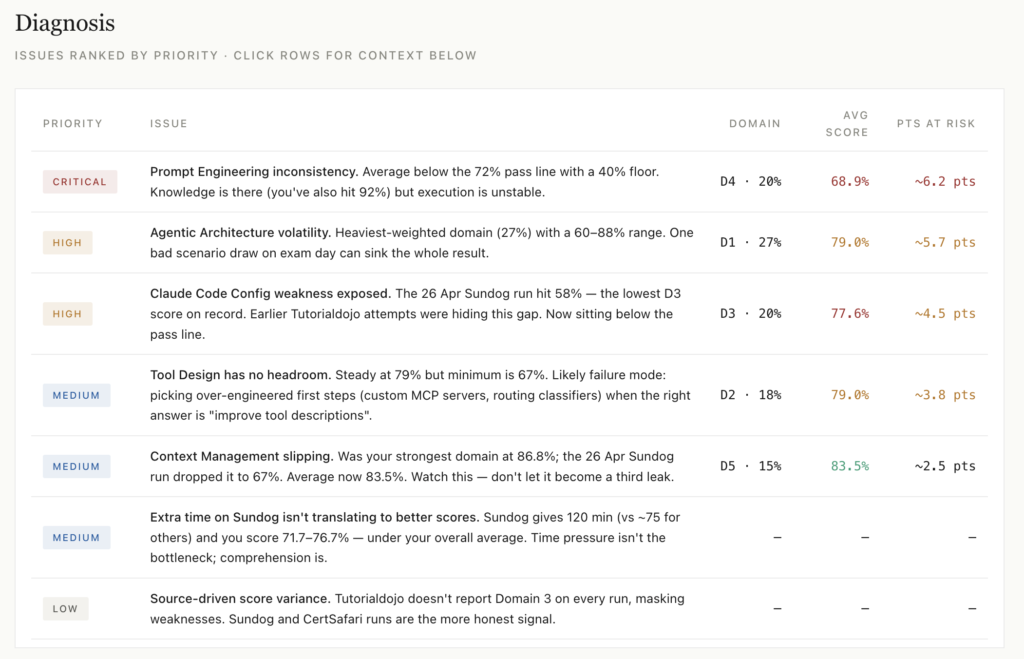
In the end, I asked Claude to generate a Diagnosis based on ways that I could improve. Each issue had a priority (based on the score and impact). It is pretty much aligned with the domain insights that I brought up in the previous paragraph.
With those numbers, I was able to:
- Spend less time in my preparation by focusing on the main things that I was failing (like specific competencies or domains)
- I felt more confident over time, which helped me find the right moment to take the exam
- Stop doing certain tactics that were not working, like spending too much time on verbose questions that were not helping to improve my scores and knowledge overall. That is one of the insights from
Diagnosis.
With those insights, let’s dive into the materials that I used for my preparation.
Resources
Here is a summary of items that I used in the process:
- Anthropic Academy:
- Building with the Claude API (The most important one, which covers the main topics. If you want to focus on one course, this is it)
- Introduction to subagents
- Model Context Protocol: Advanced Topics
- Blog posts and other resources:
- Practice Exams/Questions:
- Practice Exam: Claude Certified Architect – Foundations Certification
- CertSafari
- Udemy – TutorialDojo
Udemy – Sundog Education(I don’t recommend that one, because of the reason below)
Tip: Avoid practice/mock exams that have verbose text and multi-layered distractors that all sound plausible. The exam is a “foundations” one, so the expectations are scenario-based questions with more expected elements of the competencies.
Results
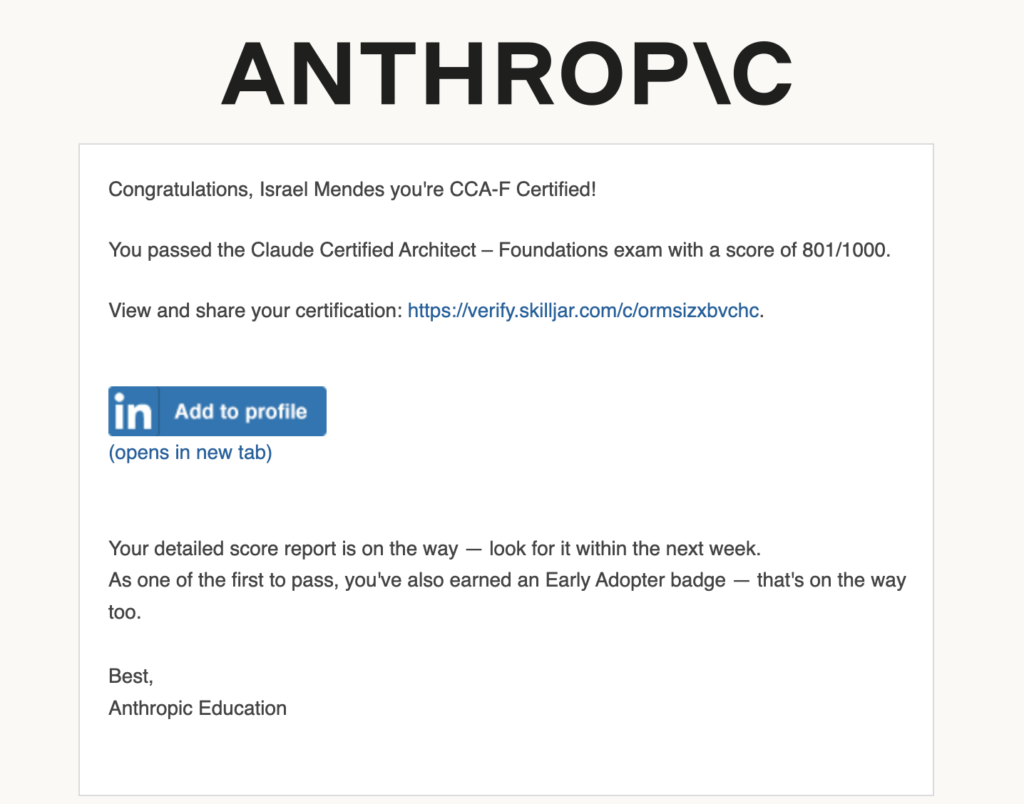
Once I completed the exam on the Anthropic site, the next day I got the results and the score (801/1000), which I noticed was close to the practice exam projected score that Claude generated (details on the previous section of this blog post).
Worth it?
As always, I like to look back and reason if it was beneficial for me to spend the time on it or not. Personally, it was super useful.
I learned a lot more about how to use AI efficiently in my workflow and in production systems. I understand that the exam right now is a bit hard to get since you need to work with a partner to take the test. If you do have the chance to go over it, I recommend you study for it and take the exam!